
Platelets are discoid-shaped and colorless with a unique
ability to reflect light. As platelets age and
eventually die, they lose their original
intended capacity. During this time, they also become
more spherical in shape and, with the high number of cells in the platelet
concentrates, the property of reflecting light gradually disappears.
Since the optical effect of
reflecting light declines with aging, CyteGuard measures and approximates the remaining viable platelets, , tracking this as a percentage corresponding to the potential efficiency of
the platelet bag during storage and can distinguish
between the aging effects of platelets and possible growth of pathogens. This means that it can also indicate contamination of a platelet bag.
While the traditional method (visual inspection of the blood product
bag) is aimed at determining the degree of swirling (e.g. good, fair, poor,
none), operators are rarely able to achieve this level of sensitivity and
consequently distinguish only between “good” and “none”. The CyteGuard system increases the sensitivity of assessing platelet
viability by measuring a “close to linear” decay over time, and can therefore
be considered quantitative
This
new quality aspect is possible due to a sophisticated double measuring system that measures both transmittance and reflectance.
Our research done with the transfusion clinic in Bochum, shows a correlation over time between measurements of platelet bags and the viability of platelets sampled from the bag. It has also shown that increasing turbidity in the bag caused (deliberately) by added microorganisms can be clearly distinguished from the normal degeneration of platelets.
Fig 1. Reflection and transmission curves from a large number of measurements over time.
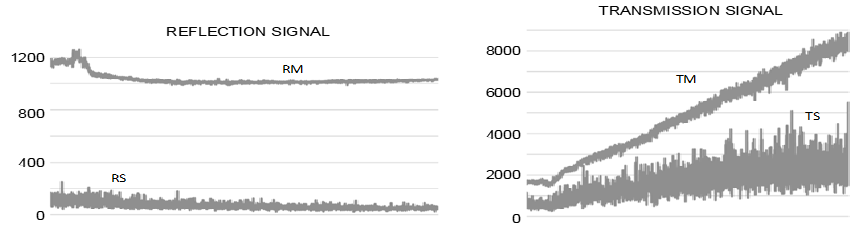
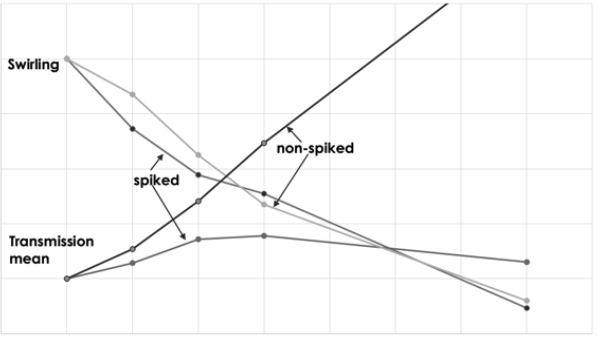
Fig 2. Calculated and
plotted curves from measurements at the transfusion center clearly showing a
decrease of viability and difference in contaminated (spiked) platelet bag.
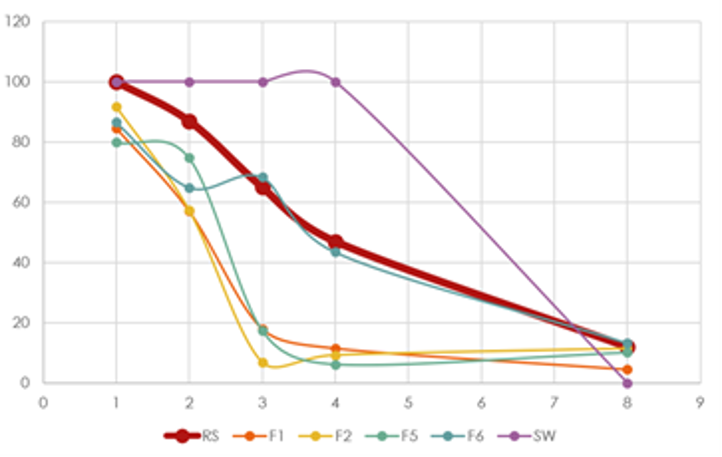
Fig 3. The purple line (visual swirling
assessment) stays at 100% for the whole storage time and drops to zero when the
platelets have died.
The thick red line
(CyteGuard method) shows a linear decay from 100% to
50% during storage time before dropping further to 0% after that.
When comparing visually assessed
swirling (purple line) to CyteGuard’s automated assessment (red line), The
conclusion is that it is very difficult to assess swirling through a visual
control.
created with
Website Builder Software .